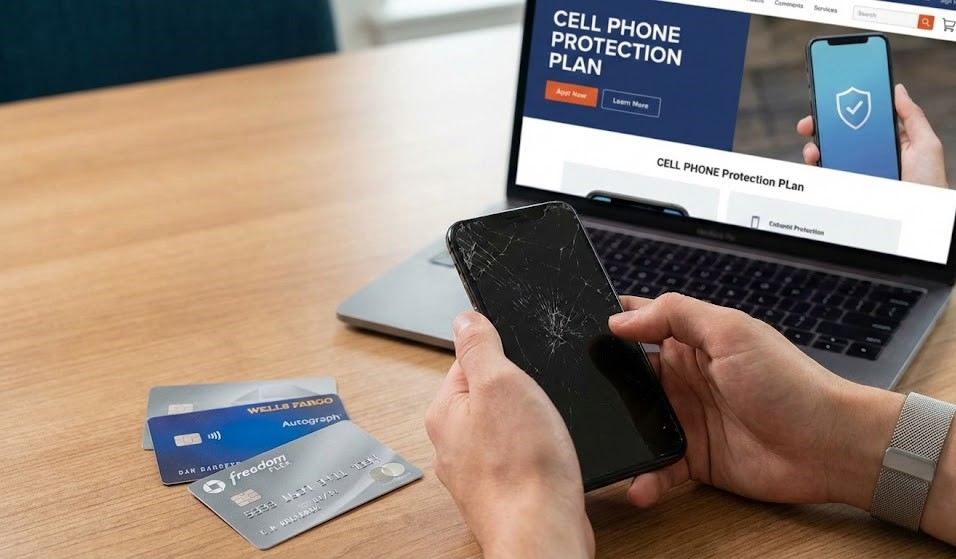
Smartphones keep getting more expensive — flagship handsets routinely top $1,200 — so using a credit card’s complimentary cell-phone protection has become one of the easiest ways to cut costs. This guide explains how the benefit works in 2026, which cards give the strongest protection, how to file claims, and practical tips so you don’t lose out.
How credit-card phone protection works (the essentials)
Most card issuers that offer phone protection make two rules non-negotiable:
- You must pay your wireless bill with the card. Coverage usually applies to phones listed on the bill you pay with that card. If you don’t pay the bill with the card, you’re not covered. (wellsfargo.com)
- Coverage is for theft and accidental damage (not mysterious loss). Typical exclusions include cosmetic damage, loss without evidence of theft, and items stolen from checked baggage. (wellsfargo.com)
Most card benefits are secondary — they pay what your primary coverage (carrier plan, homeowners/renters) does not — but some cards can act as primary if you don’t have other coverage. Confirm your card’s Guide to Benefits for the precise hierarchy. (wellsfargo.com)
Top credit-card choices for phone protection in 2026
Below are the cards widely recognised in 2026 for offering the best phone protection (coverage amounts and rules vary — read your guide):
- Chase (Freedom Flex / other eligible Chase cards) — typically up to $800 per claim and $1,000 per 12-month period, with a $50 deductible and a limit on the number of claims per year. Requirements: pay the wireless bill with the eligible Chase card. (Chase)
- Wells Fargo (Autograph and other Wells Fargo consumer cards) — many Wells Fargo consumer cards offer cellular telephone protection up to $600–$1,000 per claim with a typical $25 deductible and limits on claims per 12-month period. Check your specific card terms. (wellsfargo.com)
- American Express (selected Amex cards) — Amex cards often provide up to $800 per claim (varies by card) and common limits are two claims per 12 months; several premium and business Amex products include cell-phone protection. Always confirm the eligible card list. (American Express)
- Chase Ink Business Preferred (business card) — stands out for business users: reports and benefits pages list up to $1,000 per claim on eligible business accounts (terms apply; make sure your plan is eligible and you use the business card to pay the bill). (asksebby.com)
- Bilt (Bilt World Elite / Bilt 2.0) — Bilt-branded cards issued by Wells Fargo have been advertised with up to $800 coverage and reasonable deductibles; Bilt’s 2026 product refresh has led to some clarifications around eligibility, so confirm for your specific card. (NerdWallet)
(These examples reflect public benefit guides and reputable aggregator guides published in 2026 — always check your card’s Guide to Benefits for exact numbers and fine print.) (The Points Guy)
What’s covered — and what isn’t
Usually covered
- Accidental damage (drops, screen cracks, water damage if it caused malfunction).
- Theft (when you file a police report and supply required documents).
- In many cases, all phone lines on the bill you pay with the card can be covered (so a single card can protect family lines). (wellsfargo.com)
Usually excluded
- Cosmetic scratches that don’t impair function.
- Mysterious disappearance (no proof of theft).
- Phones stolen from checked baggage or when prohibited by the card policy.
- Manufacturer defects (warranty covers those). (wellsfargo.com)
Filing a claim in 2026 — step-by-step checklist
- Act fast — open a claim as soon as possible (many issuers require claim submission within 60–90 days of the incident). (asksebby.com)
- Document everything — photos of damage, police report for theft, IMEI and serial number, your wireless bill showing the device and the charged payment, and any repair or replacement estimate. (asksebby.com)
- Submit proof you paid the bill with the eligible card — your card statement and wireless bill are the core evidence. (Chase)
- Pay the deductible — most cards deduct $25–$100 per approved claim depending on issuer and card. (wellsfargo.com)
- Wait for insurer decision — once approved, reimbursement timelines vary (many report insurer turnaround of days to a few weeks). (asksebby.com)
Real-world calculation: when swapping saves money
Example: Family of four, carrier insurance $15/line = $60/month = $720/year. If you put the wireless bill on a card that gives phone protection and that eliminates the need for carrier plans, the card benefit can save hundreds annually even if you forgo a small autopay discount.
- Lost autopay discount: say $5/line × 4 = $20/month = $240/year.
- Carrier insurance saved: $720/year.
- Net saving: $720 − $240 = $480/year, plus you retain card perks (rewards, purchase protection). (Illustrative; run the numbers for your plan and card.)
Be careful: if the carrier discount is higher or the card’s deductible and coverage limits don’t match your needs, the swap may not be worthwhile.
Practical tips before you switch
- Read the Guide to Benefits. That document is the contract for claims — coverage limits, claim windows and required paperwork live there. (wellsfargo.com)
- Check claims limits. Many cards cap the number of claims per 12 months (commonly one or two). If you have multiple devices or a history of incidents, check annual limits. (Chase)
- Weigh autopay discounts. If your carrier gives a meaningful discount for debit/ACH autopay, calculate the break-even point.
- Confirm family-plan coverage. If your billing account covers multiple lines, some issuers extend protection to all lines on the bill paid with the card; confirm in writing. (wellsfargo.com)
- Keep records neat. Scan or photograph IMEIs, bills and approvals — paperwork makes claims smooth.
Bottom line
Credit-card phone protection has matured into a practical, high-value benefit in 2026. Cards from issuers such as Chase, Wells Fargo, and American Express (plus select business cards like Chase Ink Preferred) offer meaningful coverage — in some cases up to $1,000 per claim — that can replace recurring carrier insurance and save you a few hundred dollars a year. But success depends on the fine print: pay the bill with the eligible card, follow claim procedures, and compare saved premiums vs lost discounts.