
Artificial intelligence is changing how people work, but one problem keeps appearing across businesses, startups, and even tech teams: most people still confuse AI agents with AI copilots.
Thank you for reading this post, don't forget to subscribe!The terms are often used interchangeably. Software companies market everything as “AI-powered”, while articles online usually give vague explanations that do not help real users understand what these systems actually do.
But the difference matters more than most businesses realise.
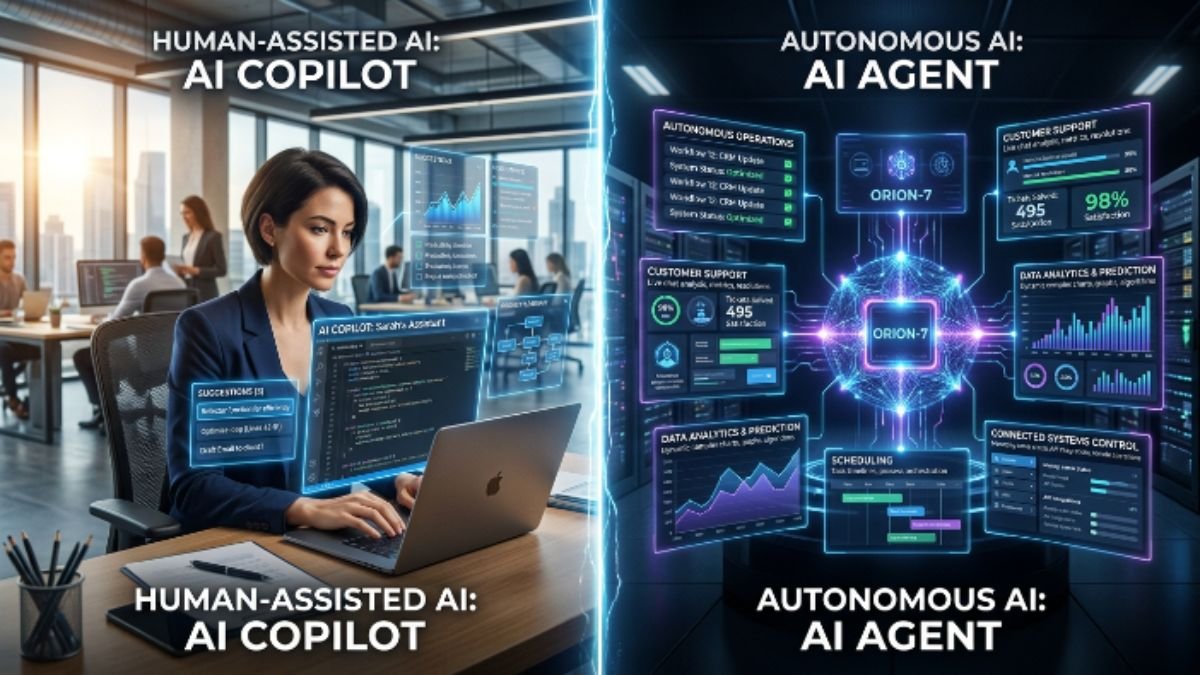
A copilot helps humans complete tasks faster. An AI agent can independently plan, decide, and execute tasks with minimal human involvement. That distinction affects productivity, staffing, automation, security, compliance, and operational risk.
Choosing the wrong approach can lead to wasted budgets, workflow failures, or systems that create more problems than they solve.
This guide explains the real difference between AI agents and copilots in simple language, how each one works, where businesses are using them today, and which option makes the most sense depending on your goals.
What Is an AI Copilot?
An AI copilot is an assistant designed to help humans perform tasks more efficiently. It works alongside the user rather than replacing them.
The human remains in control.
The AI suggests, drafts, summarises, analyses, or recommends actions, but the final decision still belongs to the user.
One of the best-known examples is GitHub Copilot, which helps developers by suggesting code while they work. Another example is Microsoft Copilot, which assists users inside Word, Excel, Teams, and Outlook.
These systems improve productivity without fully automating workflows.
Common Features of AI Copilots
AI copilots usually:
- Suggest content or actions
- Help users work faster
- Require human approval
- Operate inside existing software
- Focus on assistance rather than autonomy
Where AI Copilots Work Best
Copilots are especially useful in tasks that require:
- Human judgement
- Creativity
- Accuracy
- Compliance oversight
- Emotional intelligence
Popular Use Cases
Businesses commonly use copilots for:
- Writing emails
- Drafting reports
- Coding assistance
- Meeting summaries
- Spreadsheet analysis
- Customer support suggestions
- Research assistance
What Is an AI Agent?
An AI agent goes beyond assistance.
Instead of waiting for instructions step by step, an AI agent can independently perform tasks, make decisions, interact with tools, and complete workflows.
In simple terms:
- A copilot assists you
- An AI agent works for you
This is where modern AI becomes much more powerful — and much riskier.
AI agents can:
- Access software tools
- Use APIs
- Search databases
- Analyse information
- Make decisions
- Execute multi-step workflows
- Learn from context and memory
Some advanced agents can even coordinate with other AI agents to complete complex tasks.
How AI Agents Actually Work
Most people imagine AI agents as simple chatbots, but the real technology behind them is far more advanced.
An AI agent usually combines:
- Large language models (LLMs)
- Memory systems
- Tool integrations
- Workflow logic
- Decision-making frameworks
- Task planning systems
For example, an AI customer support agent may:
- Read a customer message
- Identify the problem
- Access internal systems
- Check order history
- Process a refund
- Send confirmation automatically
All without human involvement.
That is completely different from a copilot simply suggesting a response to a human agent.
AI Agents vs Copilots: The Core Differences
| Feature | AI Copilot | AI Agent |
|---|---|---|
| Main Purpose | Assist humans | Perform tasks autonomously |
| Human Involvement | Required | Limited or optional |
| Decision-Making | Suggestive | Independent |
| Workflow Ownership | Human-led | AI-led |
| Risk Level | Lower | Higher |
| Tool Usage | Limited | Extensive |
| Multi-Step Execution | Rare | Common |
| Best Use Case | Productivity support | Automation |
The Simplest Way to Understand the Difference
Imagine driving a car.
A copilot sits beside you and gives directions, warnings, and recommendations.
An AI agent takes the steering wheel and drives the car itself.
That is the real difference.
Why Businesses Prefer AI Copilots First
Many companies start with copilots because they are safer and easier to control.
Businesses still worry about:
- AI hallucinations
- Wrong decisions
- Compliance risks
- Data privacy
- Security problems
Copilots reduce these risks because humans remain involved.
If the AI makes a mistake, a person can catch it before action is taken.
That makes copilots attractive in industries like:
- Healthcare
- Finance
- Legal services
- Government
- Education
Why AI Agents Are Growing So Quickly
Despite the risks, AI agents are attracting huge attention because they can dramatically reduce repetitive work.
Instead of helping employees work faster, agents can potentially replace entire workflows.
This is why many companies are investing heavily in:
- AI customer service agents
- AI sales agents
- Autonomous coding systems
- AI research assistants
- AI operations management
Businesses see agents as digital workers capable of operating 24/7 without fatigue.
Real-World Examples of AI Agents and Copilots
AI Copilot Examples
GitHub Copilot
Helps developers by suggesting code snippets while programming.
Microsoft Copilot
Assists users across Office applications with drafting, analysis, and summaries.
AI Writing Assistants
Help create articles, emails, and documents while humans remain in control.
AI Agent Examples
Autonomous Customer Support Agents
Can answer queries, process refunds, and manage support tickets automatically.
AI Research Agents
Search multiple sources, analyse findings, and generate reports independently.
AI Sales Agents
Handle lead qualification, outreach, scheduling, and CRM updates automatically.
The Biggest Mistake Businesses Make
One of the most common failures happens when companies try to automate bad workflows.
AI agents do not magically fix operational problems.
They simply execute processes faster — including inefficient ones.
If a company has:
- Poor documentation
- Broken workflows
- Confusing systems
- Weak oversight
Then AI agents may amplify those problems instead of solving them.
Experienced AI consultants usually recommend:
- Fix workflows first
- Standardise processes
- Add approval systems
- Start with limited autonomy
- Gradually increase AI responsibilities
This phased approach works far better than full automation from day one.
Are Copilots Becoming AI Agents?
Yes — and this is where the industry is heading.
Many modern systems are slowly combining both approaches.
For example:
- A copilot may begin by suggesting actions
- Later it may gain permission to execute those actions automatically
This creates hybrid AI systems where humans supervise while agents handle repetitive execution.
Many experts believe the line between copilots and agents will continue to blur over the next few years.
Risks of AI Agents Most Companies Ignore
AI agents are powerful, but they also introduce serious challenges.
Hallucinations
AI may generate false information confidently.
Security Risks
Agents connected to tools and APIs may accidentally expose sensitive data.
Autonomous Errors
A single mistake can spread across multiple systems automatically.
Compliance Problems
Highly regulated industries may face legal issues if AI acts incorrectly.
Lack of Human Oversight
Too much autonomy can create operational and reputational risks.
That is why experienced organisations rarely allow unrestricted autonomy immediately.
The Hidden Technical Difference Most Articles Ignore
The real difference between copilots and agents is not the chatbot interface.
It is the permission layer.
A copilot usually suggests actions.
An AI agent executes actions.
That means companies deploying agents must carefully manage:
- Access permissions
- Tool integrations
- Audit logs
- Approval workflows
- Human override systems
This is where most real-world AI engineering effort actually happens.
Not in generating text — but in controlling what the AI is allowed to do.
Which One Should Businesses Choose?
Choose AI Copilots If:
- Human oversight is essential
- Compliance matters heavily
- Creativity is involved
- You want safer adoption
- Workflows frequently change
Choose AI Agents If:
- Tasks are repetitive
- Workflows are predictable
- Speed matters
- You need automation at scale
- You want to reduce manual operations
The Future of AI: Humans Plus Autonomous Systems
The future will likely not be fully human or fully autonomous.
Instead, businesses are moving toward hybrid systems where:
- Humans supervise
- AI copilots assist
- AI agents automate repetitive execution
This balance allows organisations to improve productivity while reducing risk.
Companies that understand this distinction early will make smarter AI investments and avoid costly automation mistakes.
Final Thoughts
AI agents and copilots may sound similar, but they solve very different problems.
Copilots improve human productivity.
AI agents automate work independently.
Neither is automatically better. The right choice depends on:
- Workflow complexity
- Risk tolerance
- Industry regulations
- Business goals
- Human oversight requirements
Businesses that rush into full autonomy without understanding these differences often struggle.
The companies succeeding with AI today are not simply adopting the newest tools. They are carefully deciding where humans should stay involved — and where AI can safely take over.


