You already know the fundamental flaw of the traditional classroom: 30 students, moving at a single pace, dictated by the middle of the bell curve.
Thank you for reading this post, don't forget to subscribe!The advanced students check out from boredom, while the struggling students quietly fall further behind. We’ve tried solving this with one-on-one tutoring, but that simply doesn’t scale. You can’t put a dedicated human expert next to every single student, every hour of the day. As a result, knowledge gaps compound, test scores flatline, and teachers burn out trying to manually adjust their lessons for 30 different minds.
But recent shifts in generative AI have finally cracked the code on personalized education at scale. Modern AI tutors don’t just spit out digital flashcards. They analyze a student’s thought process in real-time, adjusting the difficulty and providing feedback mid-sentence.
Here is a look at the latest research showing exactly how AI tutoring cuts down learning time, boosts retention, and why it works best when paired with real human educators.
What Makes Modern AI Tutors Different?
Older tutoring software relied on basic decision trees. If a student got an answer wrong, the software simply showed them a pre-written hint.
Generative AI changed the game. Today’s systems adapt on the fly. They can read a student’s uniquely flawed math equation or poorly worded thesis statement and figure out exactly where their logic went off track. Instead of just marking an answer wrong, the AI acts like a personal coach, offering highly specific guidance based on that exact mistake.
The Measurable Impact: Do AI Tutors Actually Work?
We now have peer-reviewed proof that AI tutors work. When instruction adapts to the individual, the results compound quickly: engagement goes up, mastery happens faster, and students remember the material longer.
Here is how AI-assisted learning stacks up against a traditional classroom setting:
| Metric | Traditional Classroom | AI-Assisted Tutoring | The Real-World Result |
| Feedback Loop | Days (waiting for graded tests) | Instant (micro-feedback per answer) | Stops bad habits and misconceptions before they become permanent. |
| Pacing | Fixed group speed | Dynamically adjusts to the student | Prevents boredom for fast learners and burnout for struggling ones. |
| Problem Solving | Teacher gives the final answer | AI gives hints to guide the student | Builds deep critical thinking instead of rote memorization. |
| Data Tracking | Periodic exams | Continuous tracking | Catches exact knowledge gaps long before they fail a test. |
The Core Drivers of Student Success
So, what is actually causing these massive gains in learning? It comes down to three main factors:
- Adaptive Difficulty: Instead of moving to chapter four just because the syllabus says so, AI systems measure true understanding. If a student grasps a concept quickly, the AI gives them a harder challenge. If they struggle, it quietly scales back the difficulty to review the basics.
- Psychologically Safe Practice: Let’s face it—students are often embarrassed to ask questions in front of their friends. AI provides a judgment-free zone. A student can ask an AI tutor to explain the exact same concept five times in a row without any fear of annoying the teacher.
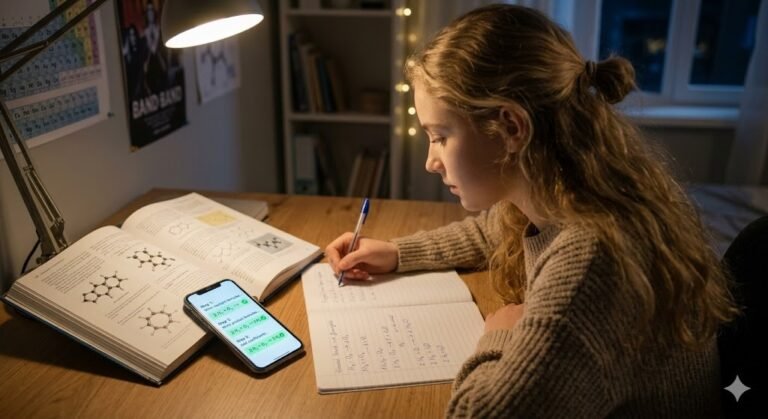
- Immediate Error Correction: Instant feedback is the ultimate learning hack. By correcting a flawed math formula the very second it happens, AI stops the student from practicing the wrong method over and over again.
The Insider Secret: Why Raw AI Fails
Here is a technical nuance most people miss: you cannot just hand a student ChatGPT and expect them to learn.
A raw Large Language Model (LLM) is programmed to be helpful. That means if a student asks, “What is the answer to problem 4?”, ChatGPT will just give them the answer. That totally bypasses the struggle required to actually learn something.
True educational AI uses something called Pedagogical Fine-Tuning. The system is trained to act as a Socratic guide. When a student asks for the answer, a well-designed AI tutor will respond: “I can help you figure that out. Let’s look at your first step. What did you try?” The effectiveness of an AI tutor comes down to forcing the student to do the heavy mental lifting.
The “Hybrid Vigor” Model: Why Teachers Aren’t Going Anywhere
Despite how powerful this technology is, AI cannot replace a human teacher.
Data proves that AI often fails unmotivated students without a human in the room to provide emotional support and accountability. Furthermore, AI can still hallucinate or drift away from the school’s approved curriculum.
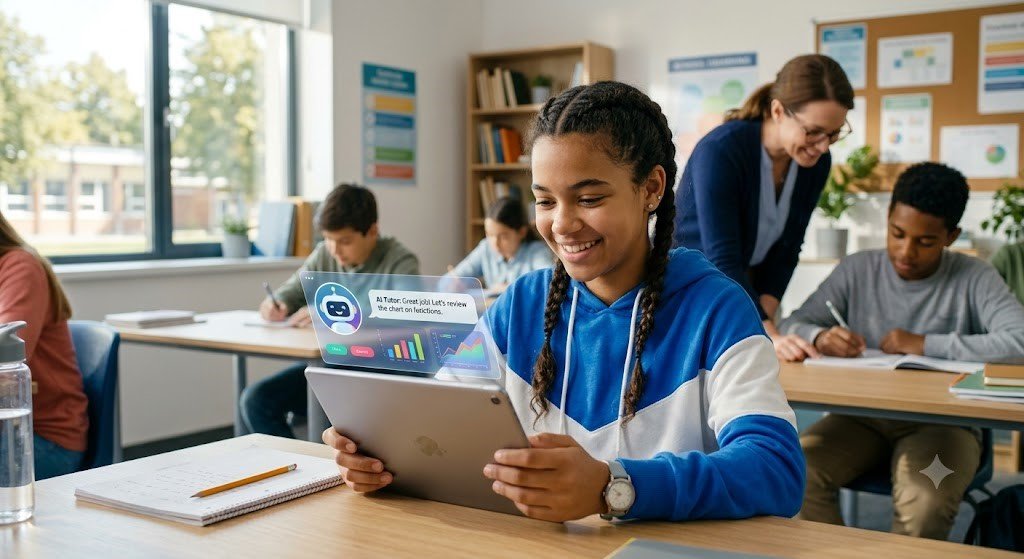
The future of education isn’t robots replacing teachers. It’s a “teacher-in-the-loop” model, where the AI handles the repetitive task of personalized grading and drilling, freeing up the human teacher to do what they do best: inspire, mentor, and connect with their students.
4. Q&A Section
Do AI tutoring systems improve student performance?
Yes. Recent data shows that AI tutors significantly reduce the time it takes for a student to master a subject. By providing instant feedback and adjusting the difficulty to match the student’s current skill level, AI prevents knowledge gaps and improves long-term memory retention.
How do intelligent tutoring systems analyze individual students?
Modern AI tutors analyze how a student answers a question, not just whether they got it right or wrong. They track response times, identify specific logical errors, and build a “cognitive model” of the student. The system then uses this data to customize the next set of questions.
What is the difference between ChatGPT and a real AI tutor?
Standard AI chatbots are designed to give direct answers, which allows students to easily cheat. Real AI tutors are built with “pedagogical guardrails.” Instead of giving away the answer, they use the Socratic method to ask guiding questions, forcing the student to solve the problem themselves.